The various case endings (including nunation) on the last word in a sentence are usually not pronounced. Nor are they pronounced before any other natural pause. In the sentence هَذا طالِبٌ جَديدٌ (This is a new male student), جَديدٌ is pronounced as jadīd.
There is an exception to the above rule which occurs with accusative case endings where there is an 'alif' and the fatha tanwīn above it. In such a case, the fathah tanwīn is pronounced as a simple 'a' instead of "an". In the sentence دَرَسْتُ كِتاباً (I studied a book), the sentence is pronounced as darastu kitāba instead of darastu kitāb. If there is an adjective attached to the noun such as دَرَسْتُ كِتاباً جَديداً (I studied a new book), then it would be pronounced as darastu kitāban jadīda. Keep in mind that it is only the last word that gets the pausal form. Notice that this only applies to pronunciation. The ending vowels are still written; just not pronounced.
If the final word before the pause is feminine with a tāʾ marbūʈa, the tāʾ marbūʈa and its case ending are not pronounced. Only the fatɧa which preceeds the Ta Marbuta is pronounced. In the sentence هَذِهِ طالِبَةٌ (this is a female student), the طالِبَةٌ is pronounced as ʈāliba instead of ʈālibatun. In regular spoken Arabic, the 't' sound of the tāʾ marbūʈa along with any case endings attached to it are rarely pronounced; only the fathah that comes before the tāʾ marbūʈa is pronounced. This makes feminine words have an 'a' sound on their end. Thus there is ʈālib for a masculine student and ʈāliba for a feminine student.
A dipthong is a sound formed by the combination of two vowels into a single syllable. The sound begins
with the first vowel and then slides into the second vowel. Examples of this would be 'coin' and 'loud'.
Arabic has two dipthongs as shown below. These dipthongs are quite common so be aware of them by paying attention to the
presence of a sukūn above ي or و .
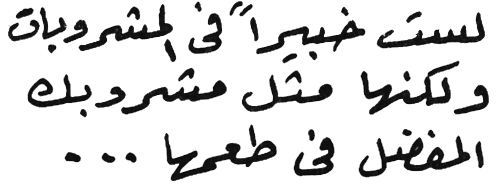
Most of the Arabic you will read is based on computer generated fonts. Arabic was orginally a handwritten language and as such it had many different ways of expressing the way it wrote and joined letters together. Sometimes where speed of writing was important, short cuts were made. If the beauty of the writing was important then beautiful caligraphy was used to stretch the various Arabic letters into pleasing shapes. Arabic ligatures refer to the different ways Arabic letters can be joined together. It is especially common in Arabic handwriting as well as in Arabic calligraphy. A simple example would joining 'alif' to 'lam' to form the word 'lā' which means 'no'. It is written as لا.
An example of handwritten Arabic is shown below.
When it comes to calligraphy there are many beautiful styles. Keep in mind that Islam forbade the use of pictures so artistic Muslims made heavy used of calligraphy to express themselves. See the example of the name 'Muhammad' below. Notice how the shadda is placed in the center at the top with the م that it refers to, centered at the bottom.